


Allows Dozens of Farmers to Upgrade to State-of-the-Art Fuel Tanks
(Long Island, NY) The Suffolk County Board of Health today voted to modify article 7 of the Suffolk County Sanitary Code in order to enhance environmental protection and also provide relief for farms and businesses that fuel and repair vehicles for their own use. The intent of Article 7 is to safeguard all the water resources of Suffolk County and special zones where toxic and hazardous materials, such as petroleum products and chlorinated solvents, are more strictly regulated.
The modifications will allow dozens of farms with old single-walled tanks to upgrade their tanks to state-of-the-art double walled systems using grants available through Suffolk County Soil and Water Conservation Service.

Brian Lewin, Sharon Frost, SC Soil District Technician, Ken Clunie, Assistant Public Health Engineer, County Executive Steve Bellone. Dr. James Tomarken, Commissioner Suffolk County Health Department, Legislator Al Krupski, Jim Meyers, Principal Public Health Engineer, Erick Lewin. Photo Credit: Suffolk County.
Article 7 of the Sanitary Code will now allow aboveground diesel storage to 1000 gallons and aboveground motor oil and used oil tanks to 300 gallons each. Previously, the limit allowed by code, which was adopted in May 1985, was 250 gallons total per site.
“Our health officials over the last few months reached out to both industry and environmentalists, listened to their concerns and collaborated with them to adapt the sanitary code so that it made sense for all stakeholders,” said Executive Steve Bellone. “This is an example of government working at its best, and this decision will result in a tremendous benefit to our farm communities in the future.”
According to Rob Carpenter of the Long Island Farm Bureau and Suffolk County Soil and Water Conservation District, funding to replace fuel storage facilities has been granted by the New York State Environmental Protection Fund and United States Department of Agriculture Natural Resources Conservation Service through their Environmental Quality Incentive Program. “Funding totals over $1.5 million, demonstrating the full support of state and federal agencies to replace fuel storage facilities,” said Carpenter.
“Farmers need to have safe fuel tanks on their land as part of their infrastructure,” said Suffolk Legislator Al Krupski, of Riverhead, who has strongly promoted the changes to the sanitary code. “The modifications will allow farmers to save on fuel costs and usage and enable them to grow and serve their customers more effectively. This is a huge benefit to our communities on the east end.”
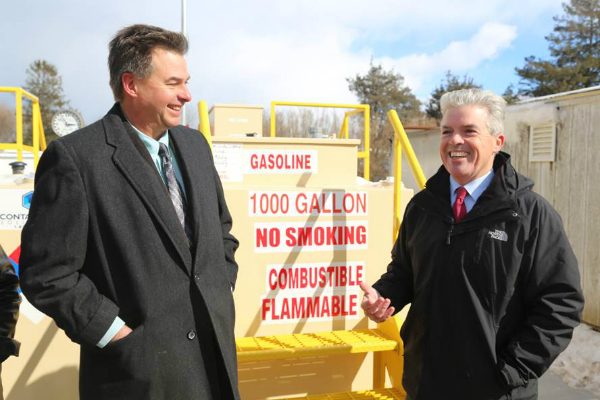
Legislator Al Krupski and County Executive Steve Bellone. Photo Credit: Suffolk County.
Suffolk Legislator William Spencer, chairman of the county health committee and member of the Suffolk County Board of Health, who was instrumental in reaching out to those with environmental concerns, said, “This change will allow facilities that fuel and maintain vehicles the ability to do so onsite instead of making repeated trips to service stations or frequently filling very small tanks, thereby reducing air pollution, fuel usage and spills that can result from repeated filling of small tanks.
“I am very comfortable recommending these changes to the sanitary code, having recently met and discussed the changes with my colleagues,” said Adrienne Esposito, Executive Director of Citizens Campaign for the Environment. “We expect that the increase in storage limits will not have a negative impact on Suffolk County’s groundwater due to stringent design requirements, inspection and additional controls required on these tanks.”
Another change to the code will allow used oil to qualify for the same exemption that exists for heating oil. This will allow companies that currently collect used oil from their fleets to place it in their heating oil tanks and heat their buildings with the used oil. This will result in lower heating bills, a reduction in use of heating oil as well as eliminate the need for transportation and disposal/processing of the used oil. It will also eliminate the need for onsite storage of used oil.
Other minor changes were also made to the code to clarify code sections, eliminate ambiguous terminology and correct errors.
The code changes took effect upon filing, which will occur by Monday, February 1, 2016. To view the Suffolk County Sanitary Code Article 7 changes, visit http://www.suffolkcountyny.gov/Departments/HealthServices/BoardofHealth.aspx.
Funding may be available for farmers to upgrade their diesel fuel tanks and to come into compliance with Article 7 regulations. For more information or a free evaluation, contact Sharon Frost at the Soil Water Conservation District at 631-852-3287.

