


(LONG ISLAND, NY) The stars are shining a bit brighter on the Suffolk County Community College Ammerman Campus with the opening of the college’s new state-of-the-art observatory where star gazers can peer into the sky and look more than a billion years back in time. Suffolk County Community College now has one of only five observatories in our county − The Vanderbilt Museum, Stony Brook University, Custer in Southold and Montauk are the other four – and Suffolk Community’s is among the largest.
In astronomy, first light is the first use of a telescope (or, in general, a new instrument) to take an astronomical image after it has been constructed. This is often not the first viewing using the telescope; optical tests have been performed to adjust the components. Despite this, a first light is always a moment of tremendous excitement, both for those who design and build the telescope and for the astronomical community at large.
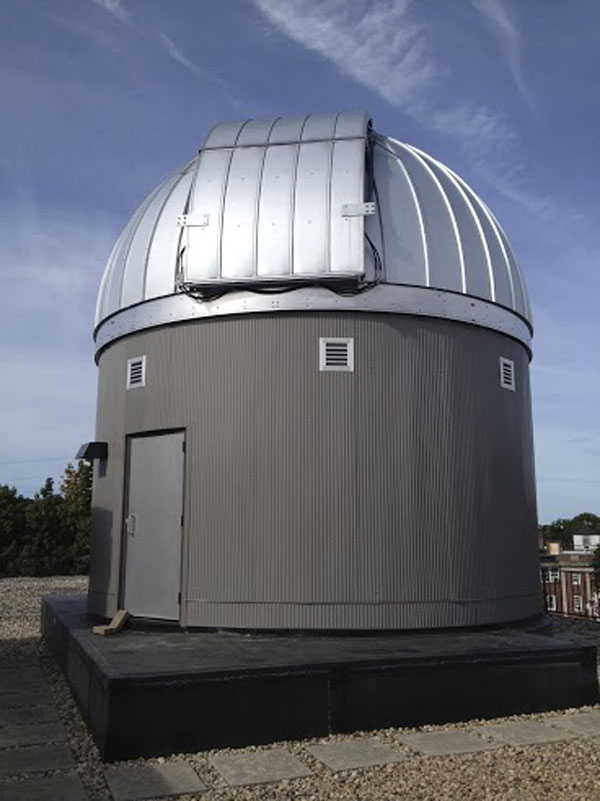 Suffolk County Community College’s new, state-of-the-art Observatory sits atop the Smithtown Science Building on the Ammerman Campus in Selden. The dome spans 20.5 feet making it one of the largest Observatories in Suffolk County.
“This is a fantastic new addition to our College,” said Suffolk County Community College President Dr. Shaun L. McKay, “that will provide research opportunities for faculty and astronomy majors, as well as enhance our college’s reputation in the scientific community while educating the public about astronomy through public outreach.”
“The College’s new observatory offers our students and faculty the opportunity to conduct research and share information with other students and scientists throughout the world,” said Suffolk County Community College Board of Trustees Chairwoman Dafny J. Irizzary, adding, “it will also serve as one more college resource available to the community at large.”
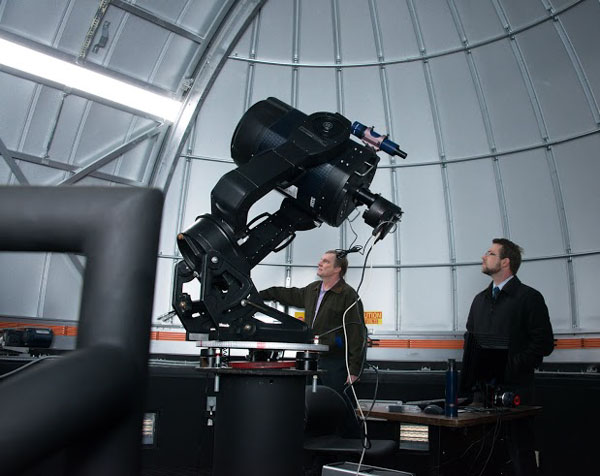 Associate Professor of Astronomy Matthew Pappas and Associate Professor Gerald Schnal watch as the Suffolk County Community College Observatory doors open to the heavens.
“The faculty is thrilled to have the observatory as a permanent house for our astronomical research equipment and for use by faculty and our astronomy majors. Not only does it allow us to investigate scientific questions, it provides an opportunity to share the excitement of looking out into the universe with the people of Suffolk County,” said Professor Thomas Breeden, Chairman of the Physical Sciences Department. “Our acquisition of the observatory validates that the County, our sponsor, has confidence in our programs and in turn demonstrates our commitment to the scientific community,” Breeden explained. “The County and College’s commitment will now enable us to apply for grants from organizations such as The National Science Foundation,” Breeden said.
“I congratulate Suffolk County Community College on the opening of its new Observatory. The research conducted will result in a greater understanding of astronomy and provide students, professors and the community at large with a new resource,” said New York State Senator and Chairman of the New York State Select Committee on Higher Education Kenneth P. LaValle.
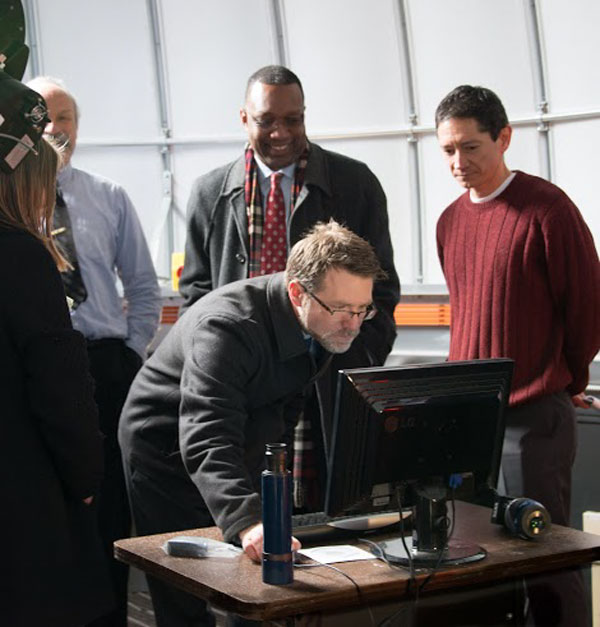 Associate Professor of Astronomy Matthew Pappas, at computer, examines images captured by the new Suffolk County Community College Observatory telescope as Professor and Physical Sciences Co-Chairman Scott A. Mandia, right, and Suffolk County Community College President Dr. Shaun L. McKay observe.
“A quality and affordable community college system is vital to the continuing health of our county and today’s grand opening is another example of how dedicated the leadership of Suffolk County Community College is to fulfilling that goal. This new addition will expand educational opportunities for our county’s young students to allow them to reach their full potential,” stated Senator John Flanagan, Chairman of the New York State Senate Committee on Education. “Congratulations to everyone involved for turning this vision into reality.”
“The new observatory at Suffolk County Community College’s Ammerman Campus showcases the institution’s groundbreaking teaching initiatives and highlights the school’s dedication to science and technology,” said Legislator Sarah Anker. “Suffolk County Community College remains at the forefront of academic research, and as Chair of the Suffolk County Legislature’s Education Committee, I continue to support our college’s educational excellence.”
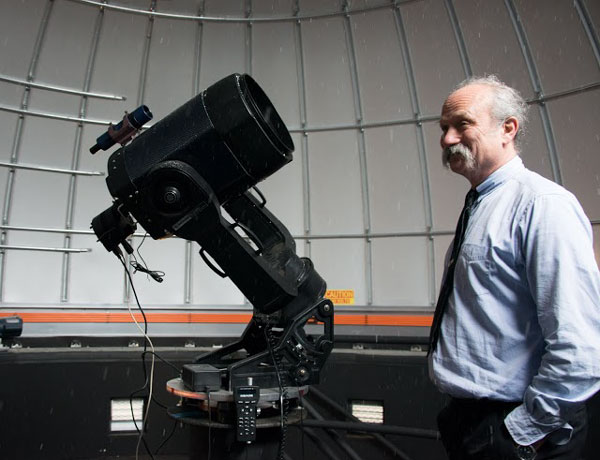 Suffolk County Community College’s Physical Sciences Department Chairman, Professor Thomas Breeden is all smiles about the opening of the College’s new Observatory. Breeden said the College’s new, powerful telescope will be utilized by student and faculty researchers and has a resolving power of 0.45 arc seconds, which is equivalent to being able to see a dime a little more than five miles away.
“I am thrilled that our community college has a new Observatory that will be a great research tool for the students majoring in physics/astronomy. Considering that the only other educational institution that has one in Suffolk County is Stony Book University, this is a very impressive addition for the college,” said Suffolk County Legislator Robert Trotta of Fort Salonga. “This is an exciting moment for our community college and our community overall,” Legislator Trotta added.
“As a Suffolk County Community College alumnus, I am proud to see the extraordinary improvements Dr. McKay and his staff have made to all of our campuses. I believe that adding an observatory to our Selden campus will not only draw our residents to the college, but will also serve as an attraction for visitors to enjoy, “said Suffolk County Legislator William J. Lindsay III.
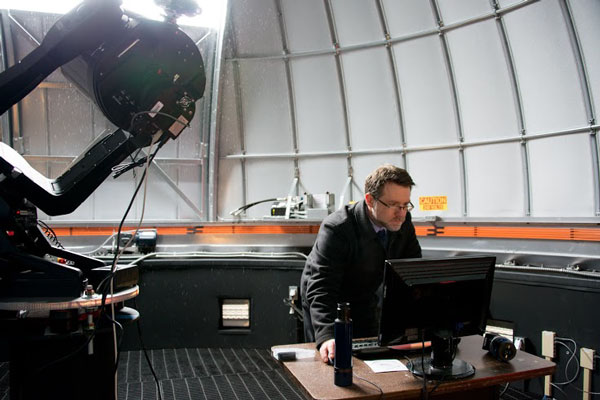 Associate Professor of Astronomy Matthew Pappas prepares Suffolk County Community College’s new Observatory and telescope.
The observatory’s 10-inch Meade RCX400 Ritchey-Chretien telescope has a resolving power of 0.45 arc seconds, which is equivalent to being able to see a dime a little more than five miles away, and is housed under a 20 ½ foot rotating dome atop the Smithtown Sciences Building and equipped with networked computer controls allowing partial operation from remote locations. Full networking and remote operation are planned in the near future.
The instrument can also be operated via electronic hand controls and is equipped with software that accesses a catalog of coordinates for 145,000 celestial objects that make viewing and moving from one object to another easier. The telescope’s primary mirror also has ultra-high transmission coatings to help increase light transmission by 20 percent, making objects brighter, and is mounted to a 12-foot-tall cylindrical metal pier that is filled with sand to dampen vibrations. There is an additional vibration dampening system on top of the pier that was designed and installed by Suffolk County Community College Science Department faculty, consisting of metal plates with rubber spacers.
Astronomers using the new telescope can also record what they are seeing through the college’s CCD Camera equipped with filters that meet astronomical research standards.
The college is working to open the Observatory, by appointment, to small groups from the public on Friday nights later this spring. College President McKay said an announcement will be made to the media, via the college’s social media channels and on its web site when the program’s details are established.

