


(Long Island, NY) Today, County Executive Bellone, Legislator Tom Cilmi, U.S. Fish and Wildlife, Seatuck Environmental Association and Suffolk officials announced the completion of a much needed dredging project for Champlins Creek in the Town of Islip. The dredging project widened the creek from 50 to 100 feet improving the navigational abilities for boaters in the area.
“Not only does this dredging project greatly improve the navigability of the creek, expanding the width from 50-100 feet for boaters who use this waterway, it also highlights an opportunity where governmental agencies can work collaboratively to serve two purposes,” said County Executive Steve Bellone. “Nitrogen pollution has been directly linked with systematically destroying our critical marshlands, wetlands, and coastal vegetation. This project will help to restore the marsh at the Seatuck Refuge and provide stronger protections for the mainland during significant weather events.”
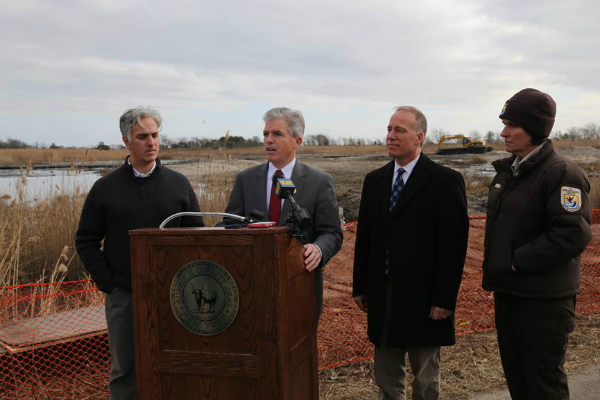
Enrico Nardone, Executive Director-Seatuck Environmental Association, County Executive Steve Bellone, Legislator Tom Cilmi Michele Potter, Refuge Manager for the Long Island National Wildlife Refuge Complex. Photo Credit: Suffolk County.
At the request of the Town of Islip, dredging of Champlins creek was added to the list of dredging projects for Suffolk County after ahydrographic survey confirmed the shoaling in the waterway. The project began on December 18, 2015 and produced approximately 7,000 cubic yards of mud which was placed at an upland dike area at the East Islip marina and 7,000 cubic yards of sand which was pumped onto an adjacent march for use by U.S. Fish and Wildlife for their Seatuck Refuge Marsh Restoration Project.
“The completion of this critical project will ensure that residents and boaters are able to enjoy Champlins Creek for years to come,” stated Islip town Supervisor Angie Carpenter. “I’d like to thank the County for having the foresight to widen the channel, and thank the crews for their hard work.”
“The cooperation between Suffolk County and the U.S. Fish and Wildlife Service on this project is yielding numerous benefits,” stated Legislator Cilmi Qutoe. “Doubling the width of the dredged area means improved navigability in the present. It also means that the County will not have to come back and dredge the Creek for a period of multiple years as opposed to what has become an annual requirement. That means meaningful savings to the County. Additionally, the ecological benefits to the salt marsh at Seatuck means better shoreline resiliency and improved wildlife habitat, including increased numbers of mosquito-eating fish and birds which will go a long way towards controlling the mosquito population. This is really great news all around.”
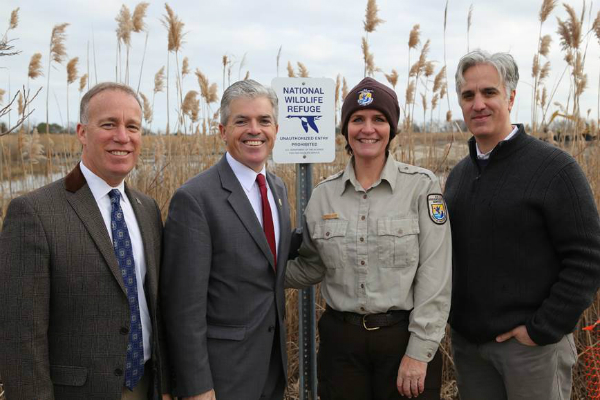
Legislator Tom Cilmi. County Executive Steve Bellone, Michelle Potter, Refuge Manager for the Long Island National Wildlife Refuge Complex, Enrico Nardone, Executive Director-Seatuck Environmental Association. Photo Credit: Suffolk County.
The restoration of the Seatuck National Wildlife Refuge falls under the auspice of U.S. Fish and Wildlife Service. The first phase of a multi-faceted saltmarsh resiliency project began at Seatuck National Wildlife Refuge (NWR) on Saturday, December 26, 2015 using the dredged sand from Champlins Creek to raise the elevation on the waterlogged areas of the marsh. Future stabilization efforts at this site will also include restoring the tidal flow by placing new natural ditches and filling some grid ditches that are no longer functioning properly. The overall project will restore the marsh and its natural tidal flow and reduce shoreline erosion.
“Congratulations to the USFWS and to County Executive Bellone and Legislator Cilmi for their visionary leadership on this important project. Restoring the health of the salt marsh will help not only the neighboring property owners, who will benefit from the marsh’s increased resiliency, but all Suffolk County citizens; the restored marsh will contribute to a better, cleaner Great South Bay and benefit our entire coastal ecosystem,” stated Enrico Nardone, Executive Director-Seatuck Environmental Association.
In October 2013, the U.S. Fish and Wildlife Service (Service) received funding to restore and enhance approximately 567 acres of salt marsh habitat impacted by Hurricane Sandy. The Seatuck resiliency project is a part of a larger restoration effort to restore marsh habitats at three units of the Long Island National Wildlife Refuge Complex. The project will help restore wetland habitat in currently degraded salt marshes, as well as help protect the nearby communities of Islip during future storms and rising sea-levels.

