


Gregory, Anker and LIRACHE Release Report on Proposed Pell Grant Freeze
(Long Island, NY) Suffolk County legislators, educators, students and business leaders have an unequivocal message for Congress: Don’t approve any federal budget that jeopardizes Pell Grant funding.
As Congress returns to Washington after the Fourth of July holiday to resume budget negotiations, Suffolk County Legislature Presiding Officer DuWayne Gregory and 6th District Legislator Sarah Anker, who chairs the Legislature’s Education and Information Technology Committee, joined with representatives of the Long Island Regional Advisory Council on Higher Education (LIRACHE) to release a report on the effects of a proposed 10-year freeze on Pell Grants, which enable low-income students to attend college. The report, which compiled findings of two hearings held this spring by Presiding Officer Gregory and Legis. Anker in conjunction with LIRACHE, will be delivered to every member of Long Island’s Congressional delegation.
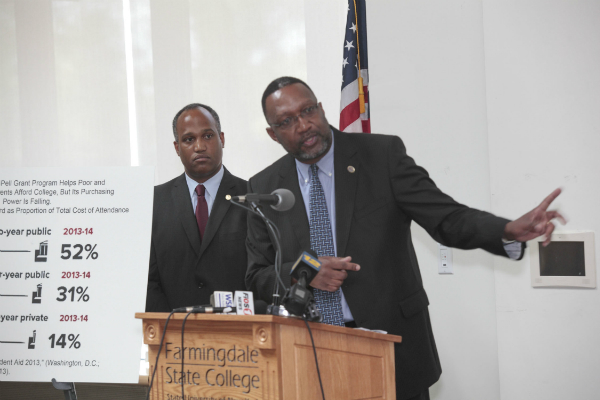
Dr. Shaun McKay, president of Suffolk County Community College, speaks to the importance of Pell Grants at a press conference held yesterday at Farmingdale State College. Suffolk County Legislature Presiding Officer DuWayne Gregory, left, looks on. Photo Credit: Steve Gravano.
“Without the Pell Grant, I wouldn’t be here today,” said Presiding Officer Gregory. “Along with my job sweeping the gym floor, the Pell Grant enabled me to get a college education, which in turn enabled me to serve in the military and now as a legislator. More than 150,000 students, or one of every 100 Pell Grant recipients in the nation, attend college on Long Island. Any change in Pell Grant funding will have dramatic effects not just on Long Island students, but also on our economy. Taxpayers’ investment in Pell students is returned many times over. Investing in higher education is not just an issue of equal opportunity, but also one of fiscal responsibility.”
Earlier this year, the House of Representatives passed a non-binding budget resolution that would cut approximately $90 billion from the federal Pell Grant program and institute a 10-year freeze on the maximum grant award. At the hearings, students, educators, financial aid administrators, and members of the business community spoke of the importance of Pell Grants to Long Island students and the Long Island economy.
Key findings in the report included the staggering statistic that of every 100 Pell Grant recipients in the country, one attends college on Long Island. The report also emphasized that the demand for education – as well as financial aid – is rising. However, the purchasing power of the Pell Grant is decreasing. In the 1979-1980 fiscal year, a maximum Pell Grant covered 99 percent of the cost of attending a two-year public institution and 77 percent of the cost of attending a four-year public institution. In 2013-2014, the maximum Pell Grant covered only 52 percent of the cost of a two-year public institution and 31 percent of the cost of a four-year public institution.
Pell Grants are particularly important to minorities and first-generation college students. Nearly two-thirds of African-American undergraduates and more than half of Latino undergraduates receive Pell Grants. Additionally, 70 percent of people without college degrees will remain in the same or fall into a lower economic station than their parents, while 55 percent of people with a college degree will perform better than their parents did.
Stony Brook University student Gina Beechay, a 26-year-old student who worked as a dental assistant before going to college, credited the Pell Grant with placing her on the path to becoming a dentist herself. “If I didn’t have it, I wouldn’t be here today,” she said at one of the hearings. “I’m blessed to be here, and it is all due to the Pell Grant, because if I didn’t have that, I would have nothing.”
“Higher education is the route to career and financial stability,” said Farmingdale State College President Dr. W. Hubert Keen, who represented LIRACHE throughout the Pell hearings. “It should not be restricted only to those with sufficient incomes or to exclude those who are non-traditional students with dependents.”
“Pell Grants are crucial to ensuring educational and socio-economic opportunity for all who aspire to it,” said Legis. Sarah Anker. “It is my genuine hope that all of Long Island’s young people can have a fair shot at the American Dream. For many, Pell Grants are the bridge to that brighter future. I strongly urge Congress to fully protect the Pell Grant program now and in the future.”
“National wealth is not wasted or lost through an investment in higher education,” said Dr. Shaun McKay, president of Suffolk County Community College. “In fact, quite the opposite is true. Research confirms what we know from experience – the availability of financial aid makes a meaningful difference in student decisions to enroll and complete college.”
“Over the next 10 years, the U.S. economy will create over 20 million jobs that will require a post-secondary degree,” said Hon. Tim Bishop, distinguished professor at St. Joseph’s College, New York. “Maintaining a strong and dependable Pell Grant, as well as other sources of student financial aid, will be absolutely essential to the aspirations of those who seek the training to fill these jobs.”
“Pell is a vitally important program that provides need-based grants to low-income undergraduate students to promote access to post-secondary education,” said Dr. Matthew Whelan, vice president for strategic initiatives at Stony Brook University. He further noted, “at Stony Brook University, 30 percent of our undergraduate students depend on Pell grants to help pay for their college education.”

