


(Long Island, N.Y.) Man, everyone loves Facebook, the networking website where people carry out a great chunk of their social lives nowadays (as sad as that may be). But was anyone expecting a Facebook movie? Not me. And was anyone expecting it to actually be exciting, engrossing, stylish, and edgy? Not me. But The Social network, directed by Mr. Fight Club himself, David Fincher, is surprisingly all of those things and more.
However, as good as The Social Network is, one tiny little factor prevented me from getting maximum enjoyment out of it; the fact that everyone involved with the creation of Facebook has confirmed that about 80% of what you see on the screen is pure fiction. Now of course, this is true for about 99.9999999% of all movies that are “based on a true story,” but usually those movies are about people who are either very obscure or very dead. It’s not often that we get a “based on a true story” movie that’s about something as recent as Facebook, which was created in 2004. “Historical” movies feel kinda weird when people are texting, blogging, and doing all the same things you’re doing today.
But the main thing that makes The Social Network hard to swallow is HOW they chose to revise history. Now, Facebook was basically made by Mark Zuckerberg and his fellow nerds, people who locked themselves in their Harvard dorm rooms 24 hours a day programming code. But according to Aaron Sorkin’s screenplay, adapted from Ben Mezrich’s nonfiction book The Accidental Billionaires (2009), Zuckerberg and company also spent an equal amount of time drinking, hitting nightclubs, wrecking rental housing, and scoring constantly with hot babes. It makes for entertaining viewing, sure, but why delve so deeply into revisionist history like that with such a well-known success story? Why not just make up your own movie?
Oh, right, it’s because Facebook is worth 25 gazillion dollars and everyone loves it. That’s a lot of potential ticket buyers, I guess.
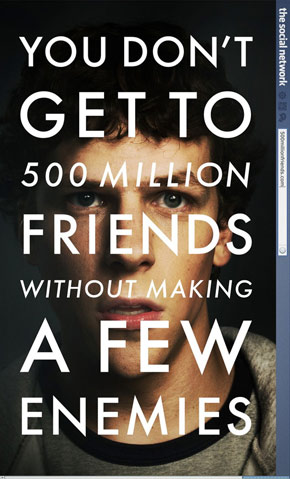 But let’s forget all that, and just concentrate on the movie itself. When judged on its own merits, The Social Network is a great movie. It tells the story of Mark Zuckerberg (played by Jesse Eisenberg, who I often mix up with actor Michael Cera), Harvard student and recently single, courtesy of his ex-girlfriend. To get even, Mark decides to get drunk and blog about her inadequacies for the whole world to read. While doing so, he gets the idea to create a “Hot or Not” style website called “FaceMash,” where Harvard students can look at pictures of their fellow female classmates and rank them on their attractiveness. This stunt gets him recognition, but it also lands him in hot water with the school’s administration.
However, twin brothers Cameron Winklevoss and Tyler Winklevoss (both played by Armie Hammer) decide Zuckerberg is the right man to get their social networking website idea off the ground after they hear about his FaceMash shenanigans. After listening to their pitch, Zuckerberg agrees to work on it, then blows off the brothers and basically goes into business for himself. While working on the precursor to
the Facebook everyone knows and loves, he recruits his rich friend Eduardo Saverin (Andrew Garfield) to bankroll the operation. All is good; Facebook launches, initially confined to the Harvard internet servers, and is an instant smash. Soon, it spreads to other college campuses and then across the world.
But problems start creeping in. The Winklevoss brothers think Zuckerberg stole their idea (he kinda did), and start pursuing bloody legal vengeance. Eduardo and Zuckerberg start disagreeing on the direction Facebook should be taking. And then Napster creator and all-around leech Sean Parker (Justin Timberlake) pops up and starts “helping” Zuckerberg get the big connections he needs to take Facebook to the next level, edging out Eduardo in the process. Will Facebook survive its dysfunctional upbringing, or come crashing down around the neck of its founder?
Why did I even bother asking that? Anybody who’s ever even touched a computer in the last five years knows what happens.
Despite the fact that The Social Network is mostly fiction, it’s still a great movie. It’s well-paced, well-acted, well-written, and has all the usual David Fincher visual flourishes. The dialogue is snappy, the conflicts compelling, and, even though you know where it’s going purely from a historical context, you still get into it. And let’s not forget Trent Reznor’s creepy and atmospheric electronic soundtrack, which
adds a great deal to the proceedings. As when he got the Dust Brothers to do the music for Fight Club, David Fincher again breaks ground with a cutting-edge score in one of his movies.
The acting is what really carries this film, and there isn’t a
weak member of the cast whatsoever. Jesse Eisenberg plays Zuckerberg almost like Dustin Hoffman’s Rain Man, oblivious to the whole world except for what affects him personally. He’s a wise ass, a motor mouth, and really not that great of a guy to his friends, but he still manages to be likable somehow.
Andrew Garfield as Eduardo showed a wide range of emotions throughout the movie, and how things turn out for his character really gets you to feel for the guy. But the big surprise for me was Justin Timberlake as Sean Parker…I’ve seen Timberlake in movies before and found him a solid actor, but he really turned it up to 11 here as the sleazy, underhanded Parker. You could almost feel the layer of slime on this guy through the screen. Kudos, Justin!
So, a movie (very loosely) based on Facebook can be good? Yup, it sure can. Go see it!

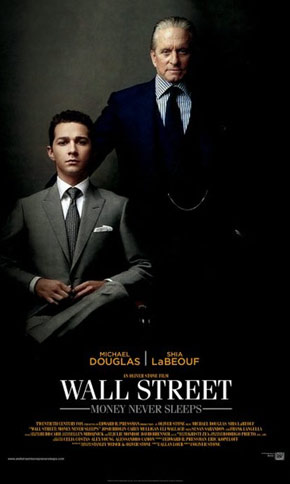 Meanwhile, Jake is working with Gekko behind Winnie’s back to re-unite the two, but is Gekko truly interested in establishing ties with his kin once again, or does he have more sinister plans? What is the eventual fate of Keller-Zabel, and what part does Bretton James play in Jake’s future? Does Jake’s fusion project find the funding it needs? Does someone have a secret $100 million trust fund? What is the importance of Winnie’s photograph? What happened to Jake’s huge account that was going under in the start of the movie, but is never mentioned again? Why does a 94 year-old Eli Wallach show up from time to time whistling like a friggin’ bird? Some of these questions might just be answered if you watch the film!
 The now fully-human Alice moves on, looking for other survivors of the zombie apocalypse. She first runs into old buddy Claire Redfield (
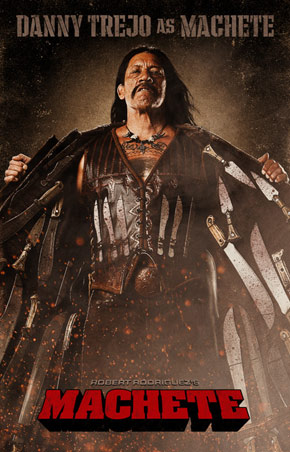 Too many corny, talky scenes, too much bad digital gore (especially where physical gore effects would have worked better- that’s just lazy), and barely any good laughs brought this movie down several notches for me. Plus, most of the action scenes seemed poorly staged and filmed, which is an oddity in a Robert Rodriguez movie. Instead of just having a blast within the exploitation genre’s conventions (which is what he claimed he was going to do), he wastes too much effort trying to build up his multi-character story, focusing more on the bad guys and co-stars at points rather than Machete, which had the effect of rendering him marginalized. The same thing happened in Rodriguez’s “Once Upon a Time in Mexico,” with similar negative results.
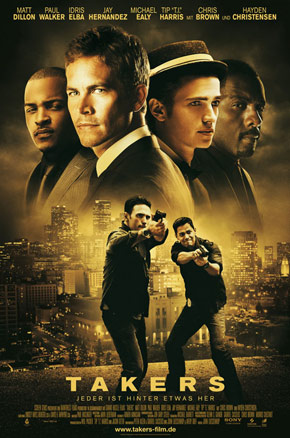 Takers’ story is unoriginal and actually pretty bad, and while the acting is nothing to write home about either, there’s at least a few stand-outs among its cast. Kid Vader…I mean,
 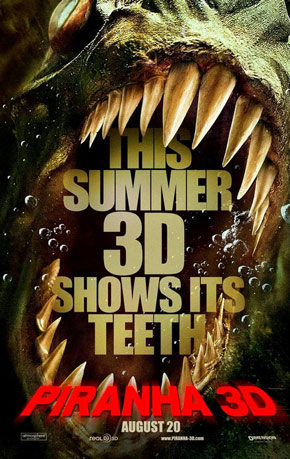 Alexandre Aja burst onto the scene in 2003 with High Tension, an awesome (the first 86 minutes) yet frustrating (the last 5 minutes) serial killer tale, and has since made a name for himself as a talented horror director. Piranha 3D’s cheese factor almost seems a bit of a step back for him, but given the film’s positive critical and box office reception, it might just help boost his career- hey, everyone has to lower their standards here and there, right? Besides, Aja manages to inject a certain degree of class into the proceedings; the 5 minute long underwater nude ballet scene is a prime example. It’s both beautiful and crazy, and damn it, I couldn’t tear my eyes away. But I’m not ashamed.
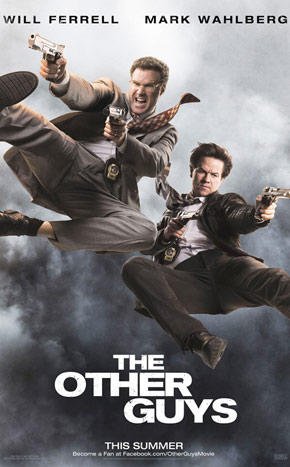 The Other Guys is a fun little movie. Will Ferrell plays…well, Will Ferrell. I mean, why does he ever play anything but a child-like goof prone to outbursts of insanity and violence? Hey, stick with your strengths, I say. Mark Wahlberg, however, is a newcomer to comedy (well, unless you count his performance in 2008’s laugh-fest The Happening), and there’s a legit novelty involved in watching him act silly instead of all hard-edged and serious. But when’s all said and done, he’s actually pretty good at being funny. And when combined, Ferrell and Wahlberg make a rather amusing duo; greater than the combined might of Cop Out’s Bruce Willis and Tracy Morgan, but falling shy of the almighty pairing of Mel Gibson and Danny Glover in Lethal Weapon, the measuring stick for all buddy cop movies until the end of time.
 Let’s get the obvious out of the way: the story is terrible; it’s beyond brain dead and often makes no sense. The dialogue is terrible; lines are delivered that you can’t believe were actually written down for other human beings to recite with a straight face. However, the violence is glorious…no, it’s not as bloodthirstily savage as Stallone’s 2008 Rambo, and it’s nothing compared to the King Of All Action Movies, Arnold Schwarzenegger’s 1985 fun-filled family classic, Commando. But The Expendables is still a hard-hitting, take-no-prisoners film that succeeds in splattering a great many bad guys like blood-filled balloons, and that’s all people are expecting (and wanting) out of it, anyway. There’s this one scene where Statham strafes a dock of baddies from the nose of a plane that’s especially satisfying.
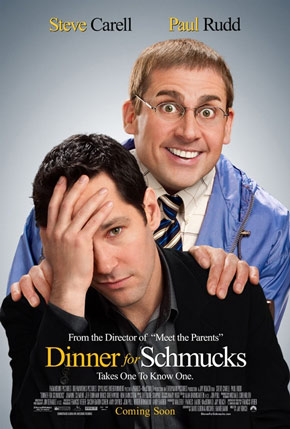 As Carell might have said in his recent Get Smart remake, Dinner for Schmucks missed the mark “by just that much.” It’s cute, and sustains a mild degree of laughs throughout, which I’d take over a dull flick with maybe or or two big laughs any day. But whoever string the footage together in the editing room…well, they needed to be a bit more ruthless. I mean, just because you filmed it doesn’t mean it should be in the movie. There are entire scenes and characters that could have been removed which would have tightened things up significantly, but as it is, Dinner for Schmucks just kind of plods along for two hours, alternating humor and ennui at every turn.
